The paradigm shift in publishing marketing
New ‘Digital Marketing Benchmarks’ by Torsten Schwarz, Absolit – interpreted for publishers
From content producer to AI infrastructure: traditional SEO isn’t dying, but it is losing its monopolistic gatekeeper role to generative AI systems. The latest edition of Torsten Schwarz’s ‘Digital Marketing Benchmarks’ reveals a historic structural shift in digital marketing. For publishers, this means that those who continue to rely solely on traditional content marketing and classic search engine optimisation will fall behind when it comes to the AI-driven discoverability of their content.
Published: 10 September 2026 | Photo / Video: Magnific | AI generated Translation (German Original)
The comprehensive survey of 2,595 marketing and advertising professionals in the DACH region (conducted by Marketing-Börse in collaboration with Horizont, Dmexco and the BVDW) paints a clear picture: Artificial intelligence has finally evolved from an experimental tool into the central operating system of modern marketing.
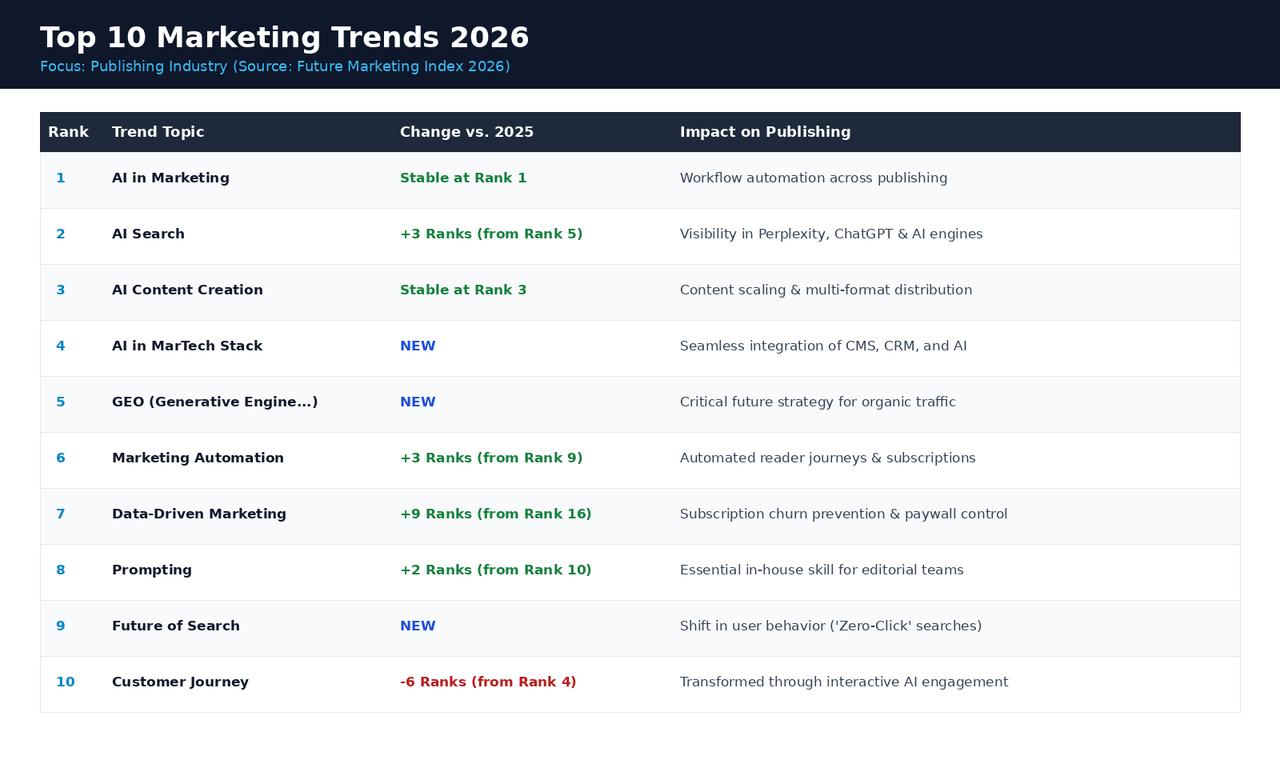
Five of the ten key marketing trends for 2026 centre directly on AI technologies. Particularly striking is the shift in priorities away from sheer volume of content towards systemic discoverability, data infrastructure and direct dialogue interfaces.
We have interpreted the general findings from the perspective of those in the publishing industry.
The most radical shift: from SEO to GEO
For publishing managers, the study sends out an alarming warning signal: traditional search engine marketing is rapidly losing its strategic importance.
• Traditional SEO has dropped from 17th place to 33rd place.
• Helpful Content drops 22 places (from 25th to 47th).
• In contrast, AI Search (ranked 2nd) and newcomer GEO (ranked 5th) have shot to the very top.
The reason: the phenomenon of ‘zero-click searches’ is increasing rapidly overall (although the study does not provide any figures on this). Users no longer search for information in order to click on blue links, but expect synthesised answers directly from AI systems (such as ChatGPT, Claude, Gemini, Perplexity or Google AI Overviews).
What does this mean for publishers? Anyone who measures AI search in the same way as traditional SEO is falling prey to a dangerous illusion of accuracy. What matters is no longer just clicks on one’s own domain, but whether the publisher’s own content, research and specialist reports are cited and processed by Large Language Models (LLMs) as an authoritative source. GEO thus becomes a discipline of ‘Brand & Content Authority’.
Devalued ‘Generic Content Marketing’ vs. Scaling via RAG
One striking finding of the study is the decline in the popularity of traditional marketing buzzwords:
• Content marketing is in freefall: still in second place in the summer of 2025, it has fallen to 18th place (-16 places) in the latest survey.
• Storytelling has seen a massive decline: it has plummeted from 6th to 16th place. Only 40 per cent (down from 79 per cent) now consider storytelling to be of primary relevance.
This by no means implies that good content has become worthless. Rather, the era of ‘low-quality content factories’ – which churned out pure SEO texts on an assembly line – is over. AI can generate unstructured, run-of-the-mill texts at the touch of a button.
The new strategy for publishers: RAG Systems
Successful media and brand examples (the study cites companies such as Kraft Heinz with its ‘TasteMaker’ RAG engine) demonstrate how AI scaling works effectively: they utilise Retrieval-Augmented Generation (RAG). By linking the AI model to the publisher’s own, copyright-protected knowledge database and archive, it is possible to create brand-compliant, highly personalised articles, newsletters and social media assets in a matter of seconds – whilst ensuring full brand safety and IP protection.
The Publishing Survival Matrix: Email & LinkedIn as indispensable channels
A look at the TV landscape reveals an extremely sharp divide between established, tried-and-tested formats and highly experimental ones:
• LinkedIn (75 per cent active / +3 per cent planned): The undisputed number one. For B2B publishers, specialist media and reader revenue in the B2B sector, LinkedIn is the critical infrastructure for thought leadership and direct sales.
• Email marketing (72% active / +4% planned): Email remains the most valuable first-party asset. As third-party cookies disappear, the newsletter is the most powerful tool for building customer loyalty and driving conversions for subscriptions.
• Podcasts (25 per cent active / +10 per cent planned): With a relative growth intention of over 40 per cent, audio/podcasts are the most dynamic channel of expansion for media companies looking to retain subscribers.
• TikTok (23% active, high engagement rate): According to the analysis, it achieved an average user engagement rate of 4.9% (compared with 1.1% for LinkedIn and 1.8% for Instagram). Whilst TikTok is a divisive topic, it is indispensable for B2C publishers looking to reach younger target audiences.
CRM, first-party data and the B2B sales revolution
In the field of CRM, there has been a marked shift from defensive regulatory issues towards proactive infrastructure:
• Data protection (from 11th to 42nd place) and consent management (from 39th to 68th place) have fallen sharply – they are now regarded as standard requirements (‘basic requirements’) that have already been met.
• The winners are first-party data (ranked 19th, up 13 places), the 360° customer view (ranked 15th, up 8 places) and predictive analytics (ranked 27th, up 8 places).
Developing ‘Single Customer Views’ within the publishing house
Case studies featured in the presentation (such as Virgin Atlantic and Adidas) demonstrate what matters most to publishers when it comes to reader marketing: linking all touchpoints (website visits, newsletter clicks, event attendance, subscription history) within a Customer Data Platform (CDP). Only then is proactive churn prevention possible – one can identify intentions to cancel before the subscriber explicitly cancels their subscription.
AI agents in publishing sales (B2B & advertising)
When it comes to marketing adverts, sponsorship and B2B subscriptions, AI agents are revolutionising the work of sales teams. As best practice shows, AI tools automatically analyse purchasing behaviour and the Ideal Customer Profile (ICP), identify website visits by decision-makers and provide the sales team with specific ways to approach contacts in real time.
Roadmap for publishing decision-makers: The four strategic areas of focus
Establishment of a GEO (Generative Engine Optimisation) strategy:
Publishers must structure their editorial and CMS systems in such a way that content can be accurately extracted by AI crawlers. This means: clear data structures, high citability, strengthening the publisher’s own author brands, and enforcing licensing and monetisation models vis-à-vis LLM providers.
Establishing a RAG-based content recycling infrastructure:
Make the most of your valuable publishing archive. With the help of in-house AI assistants (RAG), specialist articles should be automatically transformed into newsletter snippets, LinkedIn posts, podcast scripts or infographics for social media.
Focus on first-party data and direct-to-consumer (D2C):
Do not rely on platform traffic. Expanding your own newsletter network and enriching user profiles with behavioural data is the only way to avoid dependence on search engines and social media algorithms.
The use of conversational AI for reader engagement and customer support:
Conversational AI has jumped from 21st to 11th place. Interactive paywalls and intelligent chatbots in customer service reduce support costs and drastically increase subscription conversion rates.

Conclusion
The Future Marketing Index 2026 sends an unmistakable signal to the media industry: the days of isolated silos are over. Publishers who view AI merely as a cost-saving measure for editorial teams are missing the point. The winners of the 2026 transformation will be media companies that view AI as an integrated operating system – from intelligent content curation via GEO to highly personalised reader engagement in first-party CRM.
On the first day of Dmxco, 23 September, at 10.20 am, Torsten Schwarz will present the key findings of the new Digital Marketing Benchmarks on the Agencies Stage in Hall 8. The set of slides for the presentation can be ordered free of charge here.